
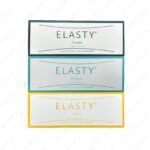

Elasty
Here’s a short product description:
Elasty dermal fillers combine cross-linked, purified hyaluronic acid with advanced 3D cross-linking technology to deliver safe, precise, and long-lasting skin rejuvenation. Sourced from non-animal origins and backed by a rigorous double-purification process, these fillers minimize allergic reactions while ensuring consistent quality. Whether smoothing fine lines, restoring facial volume, or enhancing lips and contours, Elasty’s F Plus, D Plus, and G Plus ranges — all formulated with Lidocaine — offer versatile solutions with results lasting up to 12 months.
Elasty D Plus, F Plus & G Plus — Hyaluronic Acid Dermal Fillers with Lidocaine
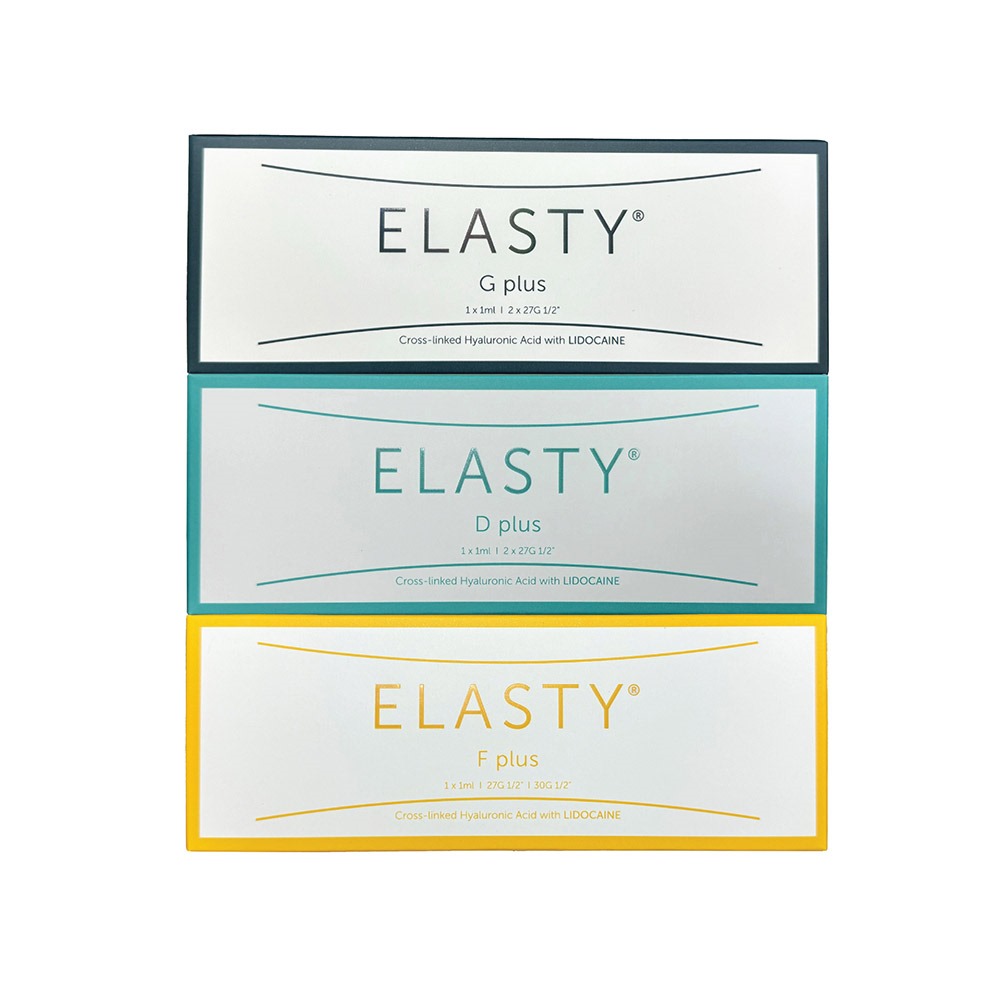
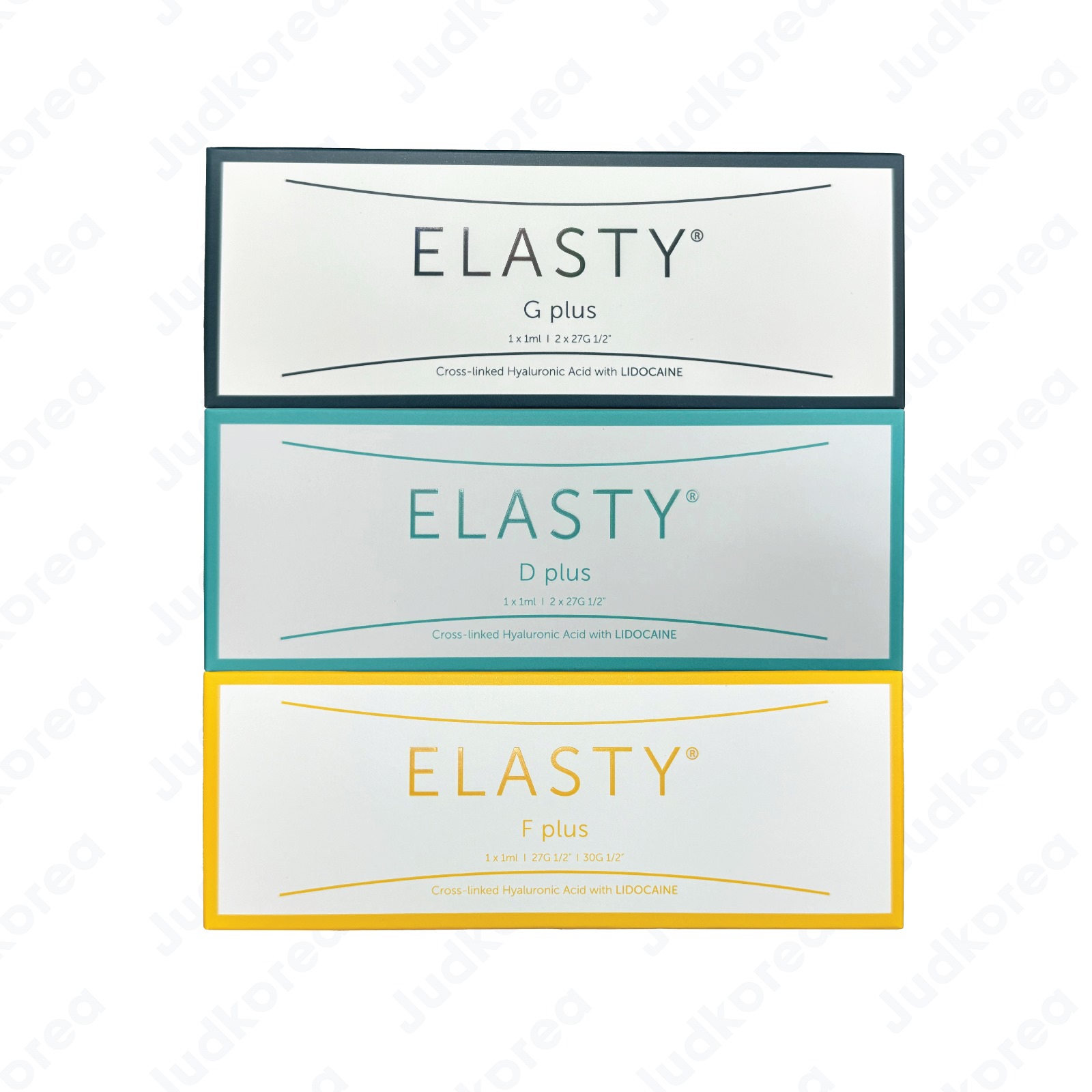
“Plus” in the Elasty naming system means lidocaine is included. The Plus variants of the Elasty filler line — Elasty F Plus, D Plus, and G Plus — share the same monophasic, 3D cross-linked HA base as their standard counterparts, with one meaningful addition: 0.3% lidocaine hydrochloride (3 mg/mL), incorporated directly into the gel. Each variant targets a distinct injection depth and correction type.
F Plus addresses superficial lines and lip border definition. D Plus handles deeper wrinkles and is the most commonly selected option for lip volume augmentation. G Plus carries the highest viscosity in the range, supporting structural lift in the cheeks, chin, and deep nasolabial folds. All three are CE certified and KFDA approved, manufactured under PNET™ 3D cross-linking technology at Dongbang Medical’s facility in Seongnam, South Korea.
Product Specification
| Product Line | Elasty F Plus, Elasty D Plus, Elasty G Plus |
| Manufacturer | Dongbang Medical Co., Ltd. — Seongnam-si, Gyeonggi-do, South Korea |
| Main Ingredient | Purified monophasic cross-linked hyaluronic acid — 24 mg/mL |
| Lidocaine (Plus) | Lidocaine hydrochloride — 3 mg/mL (0.3%) |
| Cross-Linking Agent | BDDE (low residual) — processed via PNET™ dual-wash method |
| Technology | PNET™ (Preserved Natural Entanglement Technology) · 3D cross-linking architecture |
| Packing | 2 × 1 mL prefilled syringes · 4 × 27G UTW needles included |
| Duration | F Plus: ~6 months (up to 12 with maintenance) · D Plus: 6–8 months · G Plus: up to 12 months |
| Shelf Life | 24 months from manufacturing date |
| Storage | 2–25°C · Avoid direct sunlight · Do not freeze |
| Certifications | CE certified · KFDA approved · ISO compliant · KGMP manufacturing |
| Max per session | 2.0 mL per treatment area (per manufacturer guidance) |
| User restriction | Licensed medical professionals and certified aesthetic practitioners only |
Elasty F Plus, D Plus, G Plus — How Each Variant Differs
These three variants are not interchangeable — and this is where the majority of patient-facing confusion tends to arise. Each occupies a specific viscosity tier and a corresponding injection depth. Using a high-viscosity gel like G Plus in a superficial layer is likely to produce visible irregularity; using F Plus where structural support is needed will produce a result that simply won’t hold. Viscosity selection is the starting point of any Elasty Plus treatment decision.
Elasty F Plus: Fine · Superficial · Lidocaine | Superficial Dermis · Delicate Areas
The softest gel in the Plus range. F Plus targets the superficial dermis — fine lines, subtle asymmetries, and lip border definition where precision matters more than volume.The lidocaine inclusion makes it particularly suited to the perioral zone and lower eyelid area, both of which are sensitive enough that procedural comfort is worth prioritising. Results typically hold for approximately 6 months, extending toward 12 with scheduled maintenance treatments.
- Fine forehead lines and horizontal creases
- Crow’s feet and corner-of-eye lines
- Lower eyelid contouring
- Lip border definition (vermillion edge)
- Neck lines and superficial perioral wrinkles
Elasty D Plus: Deep · Medium Viscosity · Lidocaine | Deep Dermis · Lip Volume · Folds
The mid-range viscosity option and, by most accounts, the most frequently ordered variant in the Plus line. Elasty D Plus handles deeper dermal corrections — established wrinkles, marionette lines, and perioral folds that go beyond what F can address.
It’s also the primary choice for lip volume augmentation, where the combination of sufficient body and in-situ lidocaine makes both the result and the experience more manageable. Duration typically runs 6 to 8 months in active treatment areas like the lips.
- Lip volume augmentation (body, not just border)
- Marionette lines and lower perioral creases
- Deep forehead and glabellar wrinkles
- Moderate cheek and nose augmentation
- Frown lines requiring depth correction
Elasty G Plus: Grand · High Viscosity · Lidocaine | Deep Subcutaneous · Structural Lift
The densest option in the range — and the one with the highest cohesion and elastic modulus. G Plus is injected into the deep subcutaneous layer, where it provides structural volume in areas that have lost fat pad support over time.
Cheeks, the chin platform, and severe nasolabial folds are the primary indications. Results in appropriate candidates may last up to 12 months, which makes G Plus one of the longer-lasting options at this HA concentration across any manufacturer.
- Cheek augmentation and mid-face volume
- Chin and jawline structural definition
- Deep nasolabial folds (established creases)
- Nose augmentation and bridge correction
- Deep glabellar line correction
How Long Do Elasty Plus Results Last?
- Elasty F Plus: approximately 6 months; up to 12 with maintenance
- Elasty D Plus: 6–8 months in medium-movement areas like the lips
- Elasty G Plus: up to 12 months in well-suited structural zones
What Elasty Plus Fillers Offer Clinically
The benefits below apply across all three Plus variants. The degree to which each applies varies by product: G Plus delivers greater volumising effect; F Plus contributes more to texture refinement at a superficial level. Some items are specific to the Plus configuration and don’t apply to the standard (no-lidocaine) range.
- Graduated viscosity across F, D, and G allows precision matching to correction depth
- Integrated lidocaine reduces procedural discomfort in sensitive treatment zones
- Low BDDE modification degree appears to improve biocompatibility in tissue
- 3D gel architecture maintains shape under mechanical pressure
- PNET™ dual-wash process reduces residual cross-linking agent content
- 27G UTW needles minimise injection trauma at the entry point
- CE-certified and KFDA-approved across all variants
- High cohesion reduces post-injection migration risk in placement zones
- Duration of 6–12 months depending on variant and treatment area
- HA water-binding capacity supports a moisturising effect at the correction site
- Suitable for thin and sensitive skin at appropriate viscosity levels (F Plus)
- Double-purification manufacturing process reduces bacterial contamination risk
Who Is a Good Candidate for Elasty Plus Filler?
Elasty Plus fillers are appropriate for adults seeking non-surgical correction of facial lines, volume loss, or contour improvement through a licensed aesthetic practitioner. Candidate suitability depends on the specific concern, the area being treated, and — critically — the variant selected.
The Plus configuration is particularly relevant for patients who have a low pain threshold or who are being treated in anatomically sensitive zones where in-situ anaesthesia adds meaningful procedural value.
Patients with thin or sensitive skin who have had reactions to other HA fillers may find the low-BDDE formulation more tolerable, though individual responses vary and no filler is categorically free of all risk.
Those with a personal or family history of hypertrophic scarring should discuss this with their practitioner before proceeding — it’s not a formal contraindication, but it does change the risk profile.
PNET™ Cross-Linking Technology — What It Actually Means
PNET™ (Preserved Natural Entanglement Technology): All Elasty Plus variants are built on the same PNET™ cross-linking platform. The process uses BDDE (butanediol diglycidyl ether) — the standard cross-linking agent across the HA filler industry — but at a notably lower quantity than conventional manufacturing methods.
Following cross-linking, two sequential washing stages are applied: the first removes inactive open-cross-linked BDDE residues; the second clears free BDDE molecules that did not react during the process.
The result is a gel with a low modification degree (MoD), meaning the HA chains remain close to their native structural configuration. In principle, this may correlate with improved tissue integration and a reduced likelihood of localised inflammatory reactions, though head-to-head clinical data comparing PNET™ directly against other methods remains limited in the published literature.
The 3D cross-linking architecture — rather than simpler linear chain bonding — contributes to the gel’s volumetric stability under tissue pressure. This is particularly relevant for G Plus, where the gel needs to resist deformation in areas subject to movement and mechanical load, like the cheeks during chewing or the chin during speech.
Whether this translates to a measurable longevity advantage over similarly positioned products is difficult to confirm without direct comparison data, but the structural principle appears sound.